

Rare Disease Day 2026: Why Innovation in Rare CNS Disorders Matters More Than Ever
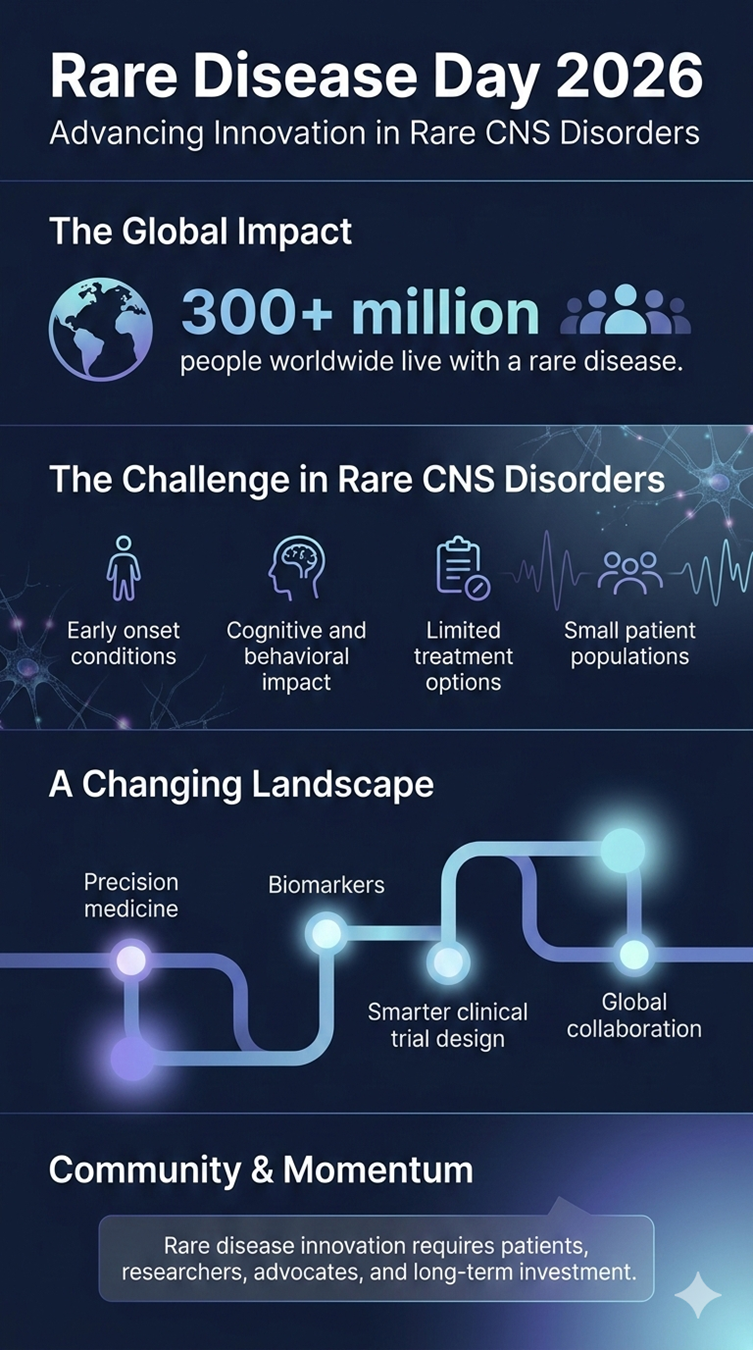
Every year on Rare Disease Day, the world pauses to remember what lies behind the numbers. More than 300 million people worldwide are living with a rare disease, but the real story is the parent sitting in another waiting room with no answers, the child who aged out of a pediatric program before a treatment was found, the family reordering their entire life around a condition that most doctors have never seen. These are the people at the center of everything we do.
For those affected by rare central nervous system (CNS) disorders, that burden can be especially profound. Many of these conditions begin in childhood, shaping, and too often limiting, cognition, behavior, learning, and independence for a lifetime. Families manage complex symptoms with access to only a small number of specialists who truly know these conditions and, in many cases, no approved treatment at all.
At ConSynance Therapeutics, this is the reality we work toward changing every day.
Rare Disease Day is a reminder that while each condition may affect a small population, collectively, rare diseases represent one of the largest areas of unmet medical need in healthcare.
The Unique Challenges of Rare CNS Disorders
Developing therapies for rare CNS conditions is not straightforward. These disorders frequently present with heterogeneous symptoms, require specialized clinical expertise, depend on sensitive and sometimes subjective endpoints, and involve small, geographically dispersed patient populations.
Traditional drug development models were not built for this reality. As a result, promising science can struggle to translate into meaningful therapies, delaying progress for patients who urgently need new options.
The challenge is not a lack of scientific insight. It is the difficulty of applying that science efficiently and rigorously within small, high-variability populations.
The Role of the Rare Disease Community
Progress in rare disease does not happen in isolation. It is built through patients and families who share data and open their lives to research; through advocacy organizations that fund early science and amplify voices that would otherwise go unheard; through clinicians who dedicate careers to conditions that most of their colleagues will never encounter. It is also built through researchers and biotech innovators willing to tackle genuinely hard problems, and through investors who recognize both the impact and the compelling long-term opportunity in rare disease innovation.
Rare Disease Day highlights the importance of this ecosystem. Meaningful progress requires alignment, science, capital, collaboration, and compassion, working together toward measurable outcomes.
A New Era for Rare Disease Innovation
For the first time, the scientific and operational tools exist to approach rare CNS disorders differently.
Advances in neuroscience, biomarker development, precision dosing, AI-enabled analytics, and global collaboration are opening new possibilities. Objective measures, including digital tools and neurophysiological markers, are helping reduce uncertainty in clinical trials. Improved patient identification strategies and more focused trial designs are increasing the likelihood of detecting true therapeutic benefit.
Regulators have also provided clearer pathways for orphan indications, recognizing both the urgency and the feasibility of rare disease development.
What was once considered too complex or too risky is increasingly becoming achievable.
Rare disease drug development has historically been perceived as high risk. Yet today it represents one of the most scientifically grounded and impact-driven areas of biotechnology. Modern tools and disciplined development strategies can meaningfully improve the probability of clinical success while deploying capital more efficiently, and when the science is right and the execution is rigorous, the result is value creation that is both durable and differentiated.
Looking Forward
Rare Disease Day is about visibility, but it is also about momentum.
It is about recognizing that patients with rare CNS disorders deserve the same urgency and innovation as those with more common conditions. It is about building smarter systems that reduce uncertainty rather than amplify it. It is about aligning rigorous science with long-term commitment.
On Rare Disease Day, and every day that follows, ConSynance remains committed to the patients still waiting. Together, we can accelerate progress for the rare disease community.
If you share our belief that rare CNS disorders deserve better science, smarter development, and genuine urgency, we’d welcome the conversation.


Comments